

Your Custom Text Here
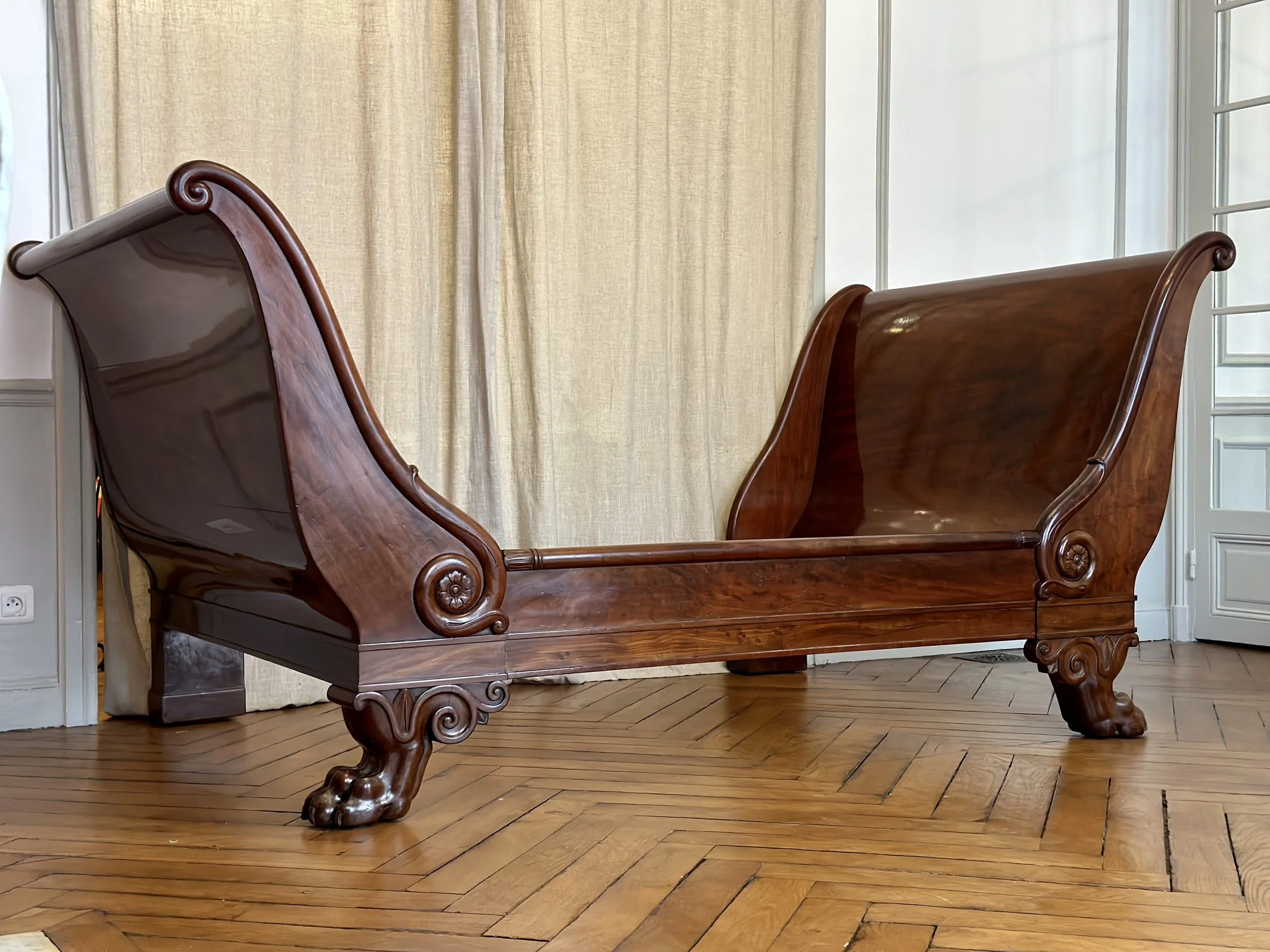
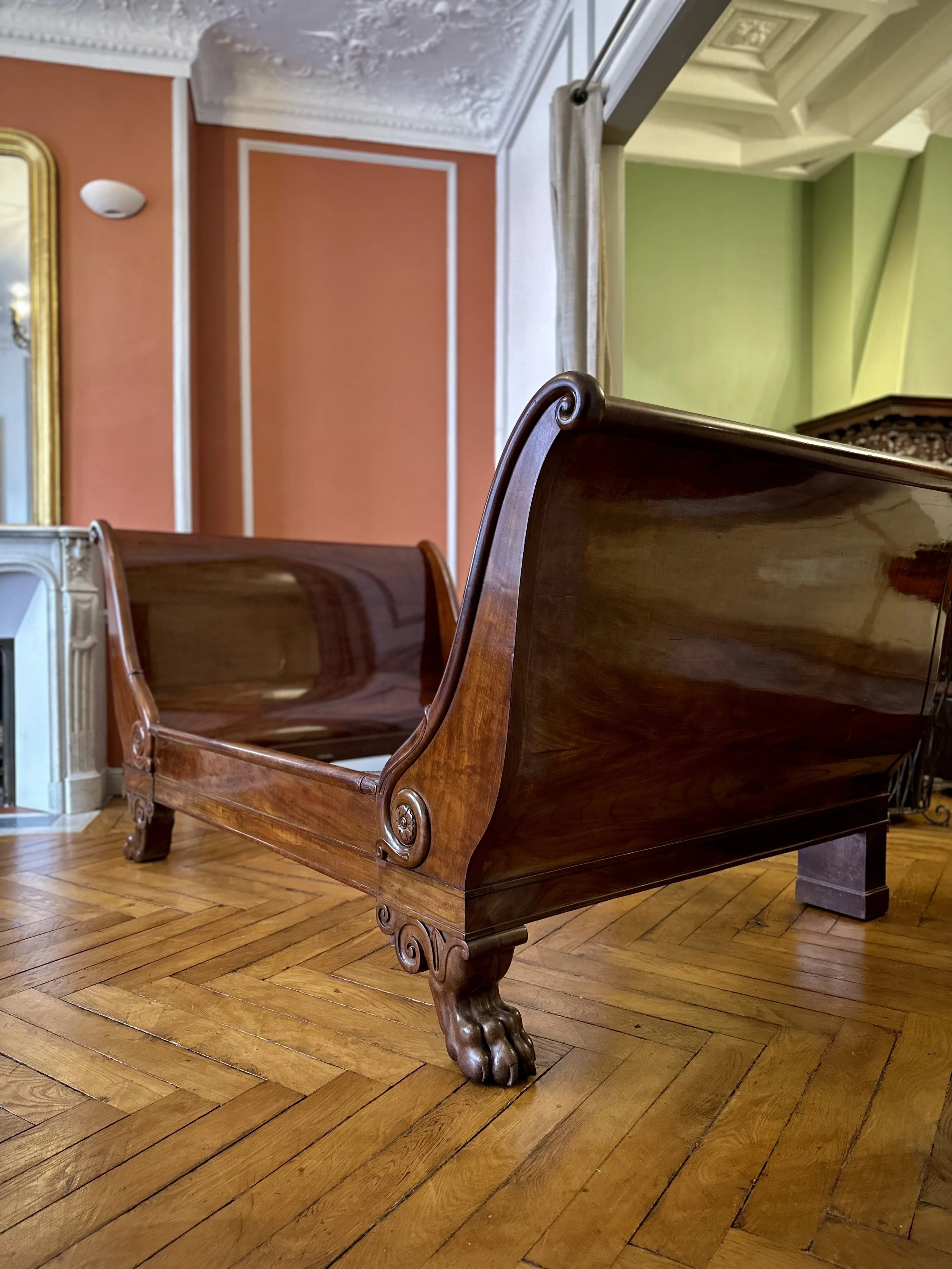
A spectacular lit bateau or boat bed in mahogany, resting on claw feet and casters which once allowed for the bed to be rolled out from an alcove or elaborate canopy of curtains to be made.
Although rarely used today, if anything as a sofa or decorative daybed, these pieces were once staples in fine interiors of the late 18th to mid 19th centuries.
This example bears the discreet stamp of the Jacob workshop, one of the most important fine furniture firms in Art History. The first Jacobs worked for instance for Marie-Antoinette, subsequent generations for Napoleon, and finally the last Jacob, Georges-Alphonse, who took over the workshop around the time this bed was created (1825) boasts works now displayed in the Metropolitan Museum of Art and the Royal Collection Trust to name a few.
As with other “late empire” works of decorative art presented by the gallery, this one demonstrates the evolution of the Napoleonic style after the fall of the empire. The form remains robust, and clearly still made of highly polished mahogany, but the design is softened by graceful curves. The decorative vocabulary, still neoclassical, follows in suit and becomes more floral than militaristic, evoking for instance Roman Egypt or life along the Nile in the Ancient World.
H: 44 inches. L: 7ft 10 inches. D: 54 inches.
Myers & Monroe, LLC
A spectacular lit bateau or boat bed in mahogany, resting on claw feet and casters which once allowed for the bed to be rolled out from an alcove or elaborate canopy of curtains to be made.
Although rarely used today, if anything as a sofa or decorative daybed, these pieces were once staples in fine interiors of the late 18th to mid 19th centuries.
This example bears the discreet stamp of the Jacob workshop, one of the most important fine furniture firms in Art History. The first Jacobs worked for instance for Marie-Antoinette, subsequent generations for Napoleon, and finally the last Jacob, Georges-Alphonse, who took over the workshop around the time this bed was created (1825) boasts works now displayed in the Metropolitan Museum of Art and the Royal Collection Trust to name a few.
As with other “late empire” works of decorative art presented by the gallery, this one demonstrates the evolution of the Napoleonic style after the fall of the empire. The form remains robust, and clearly still made of highly polished mahogany, but the design is softened by graceful curves. The decorative vocabulary, still neoclassical, follows in suit and becomes more floral than militaristic, evoking for instance Roman Egypt or life along the Nile in the Ancient World.
H: 44 inches. L: 7ft 10 inches. D: 54 inches.
Myers & Monroe, LLC
Quisque iaculis facilisis lacinia. Mauris euismod pellentesque tellus sit amet mollis.