• Gallery
  • History
  • News
  • Contact
  • About
Menu

MYERS & MONROE

Appointment Only
Kansas City, MO,
+1 (816) 606 4277
Antiquaires

Your Custom Text Here

MYERS & MONROE

  • Gallery
  • History
  • News
  • Contact
  • About

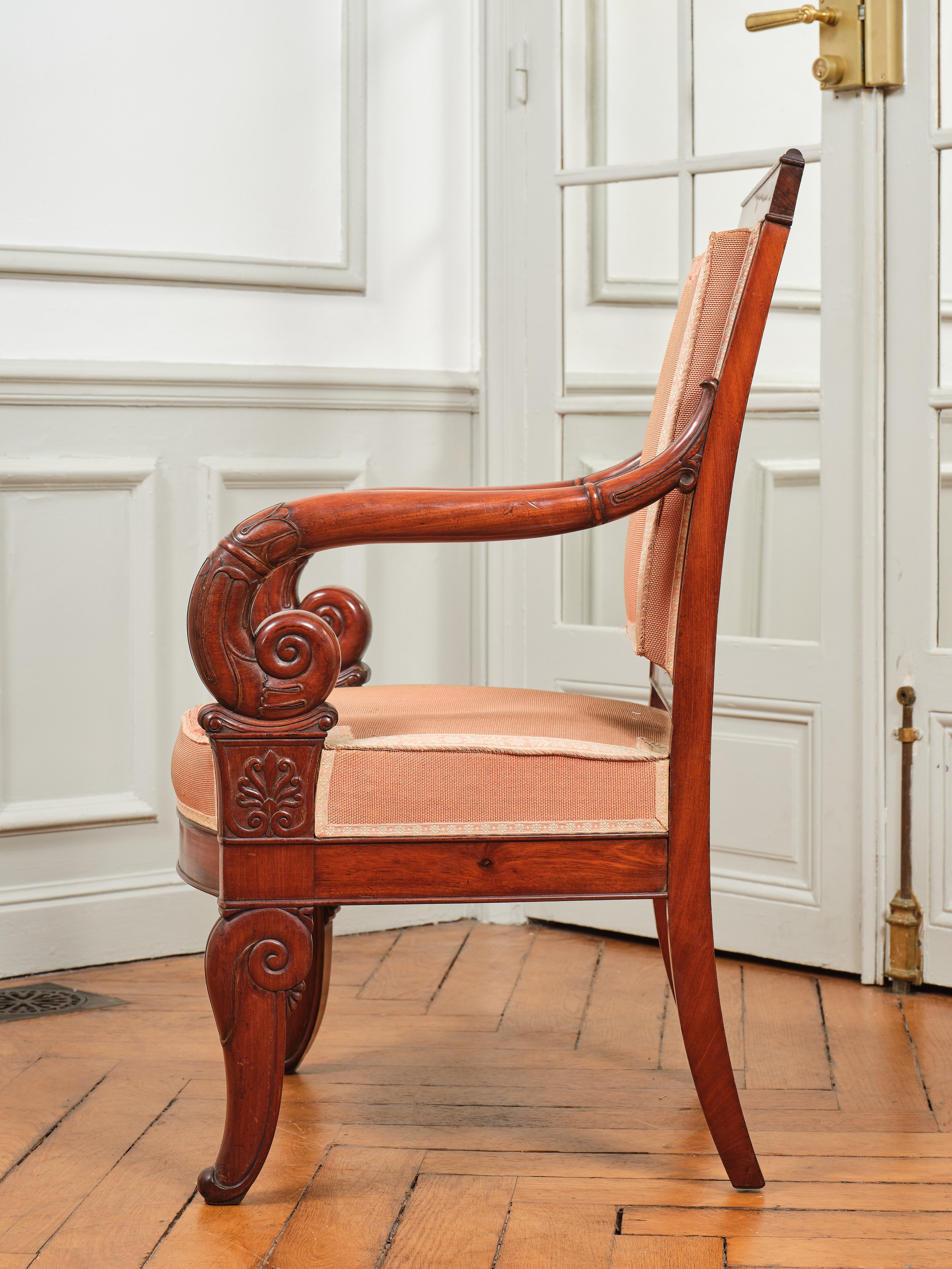
Suite of four Armchairs circa 1825-30 by Jeanselme

The Jeanselme family firm was established in 1824 specializing in seating, and it later grew to become official furnisher of King Louis Philippe and Emperor Napoleon III. In 1847, Jeanselme purchased the Jacob family dynasty’s company, thereby absorbing and continuing in the tradition of the leading French manufacturer of the previous era, if not the previous seventy-five years. By the end of the 19th century, with a third generation of ownership, Jeanselme had become the largest fine furniture firm in Paris, exhibiting at various World’s Fairs and eventually closing shop in the 1930s.

The present suite of armchairs is a fine example of their early production circa 1830, and a memorable example of “late empire work.” A certain grandeur or severity is retained from the previous napoleonic period in the stark square backs which are however already softened by a subtle curve. The decorative vocabulary is still inspired by classicism, but it has become less militaristic and serious. This late phase in the evolution of French neoclassicism favors a more graceful, floral, if not tropical and Nilotic take on the Ancient World. Ironically, although quite symmetrical and orderly, these works have become almost as curvy as the 18th century rococo style that the neoclassical movement supposedly intended to correct.

Generally one might encounter a chair of this variety and period with less beautiful mahogany and an absence of the precise carvings we see here. The cuisse de grenouille or “frogs leg” front feet are emblematic of seating of the restoration period, used approximately from 1815~1840. On these, they are particularly robust. The sculpted palmettes on the sides of the chairs, below the scrolling armrests, are remarkably precise in their execution, and perhaps the most striking feature.

These interestingly conserve their original under-upholstery, with period burlap and horsehair underneath the tired peach colored fabric from the 1960s (albeit with well selected period recreation passementerie borders). This exquisite under-upholstery lends the fine lines, precise angles, and boxed look of the backs, for instance. It also lends character to these nearly two-hundred year old works. Having this remade today would exceed this cost of the actual chairs and it would be complicated. So these are ready for a simple recovering, requiring roughly 1.5 yards of material per chair, with which the gallery is happy to assist.

H: 37 inches. W: 24 inches. D: 17 inches.

Myers & Monroe, LLC
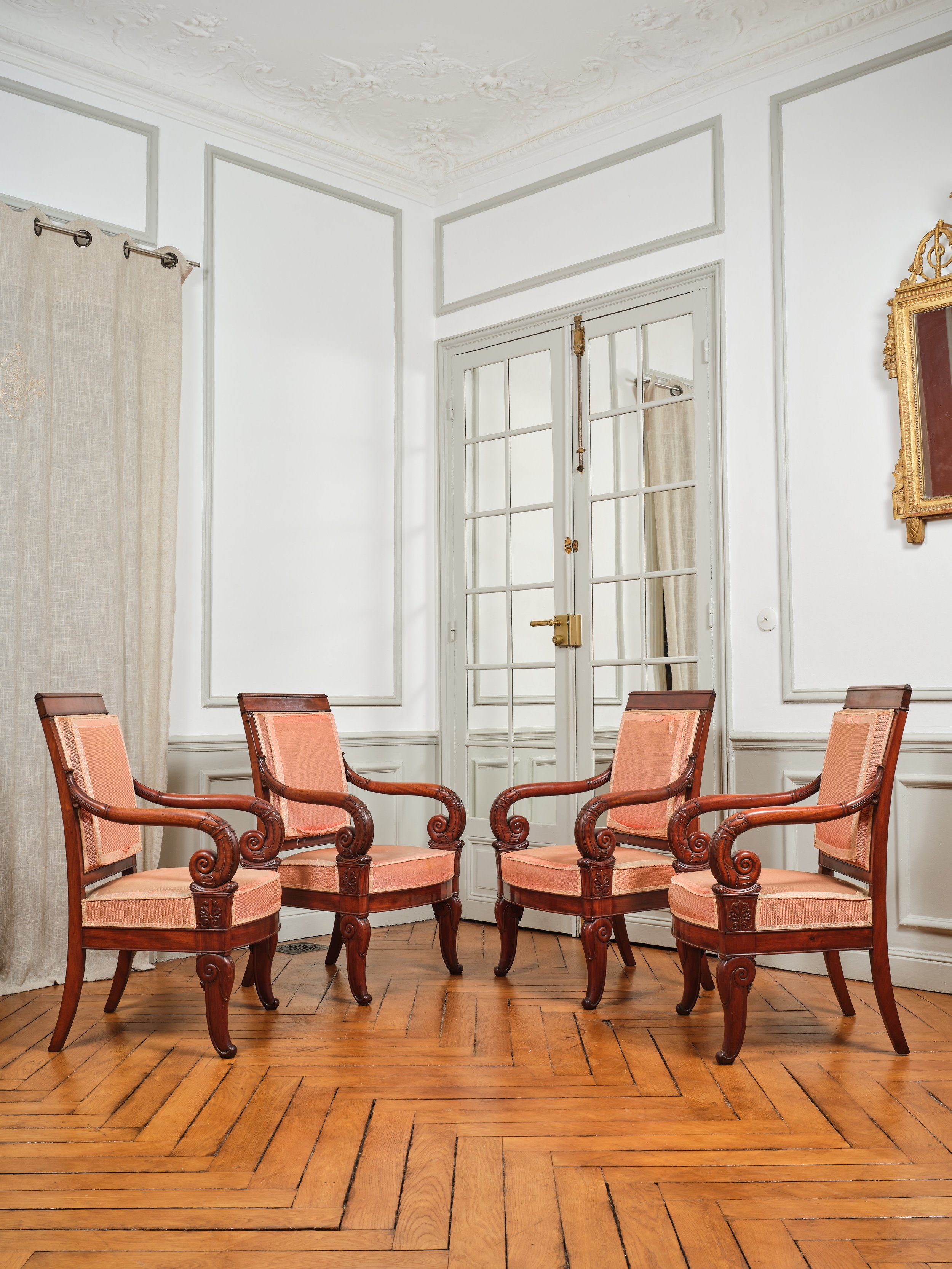
Suite of four Armchairs circa 1825-30 by Jeanselme

The Jeanselme family firm was established in 1824 specializing in seating, and it later grew to become official furnisher of King Louis Philippe and Emperor Napoleon III. In 1847, Jeanselme purchased the Jacob family dynasty’s company, thereby absorbing and continuing in the tradition of the leading French manufacturer of the previous era, if not the previous seventy-five years. By the end of the 19th century, with a third generation of ownership, Jeanselme had become the largest fine furniture firm in Paris, exhibiting at various World’s Fairs and eventually closing shop in the 1930s.

The present suite of armchairs is a fine example of their early production circa 1830, and a memorable example of “late empire work.” A certain grandeur or severity is retained from the previous napoleonic period in the stark square backs which are however already softened by a subtle curve. The decorative vocabulary is still inspired by classicism, but it has become less militaristic and serious. This late phase in the evolution of French neoclassicism favors a more graceful, floral, if not tropical and Nilotic take on the Ancient World. Ironically, although quite symmetrical and orderly, these works have become almost as curvy as the 18th century rococo style that the neoclassical movement supposedly intended to correct.

Generally one might encounter a chair of this variety and period with less beautiful mahogany and an absence of the precise carvings we see here. The cuisse de grenouille or “frogs leg” front feet are emblematic of seating of the restoration period, used approximately from 1815~1840. On these, they are particularly robust. The sculpted palmettes on the sides of the chairs, below the scrolling armrests, are remarkably precise in their execution, and perhaps the most striking feature.

These interestingly conserve their original under-upholstery, with period burlap and horsehair underneath the tired peach colored fabric from the 1960s (albeit with well selected period recreation passementerie borders). This exquisite under-upholstery lends the fine lines, precise angles, and boxed look of the backs, for instance. It also lends character to these nearly two-hundred year old works. Having this remade today would exceed this cost of the actual chairs and it would be complicated. So these are ready for a simple recovering, requiring roughly 1.5 yards of material per chair, with which the gallery is happy to assist.

H: 37 inches. W: 24 inches. D: 17 inches.

Myers & Monroe, LLC
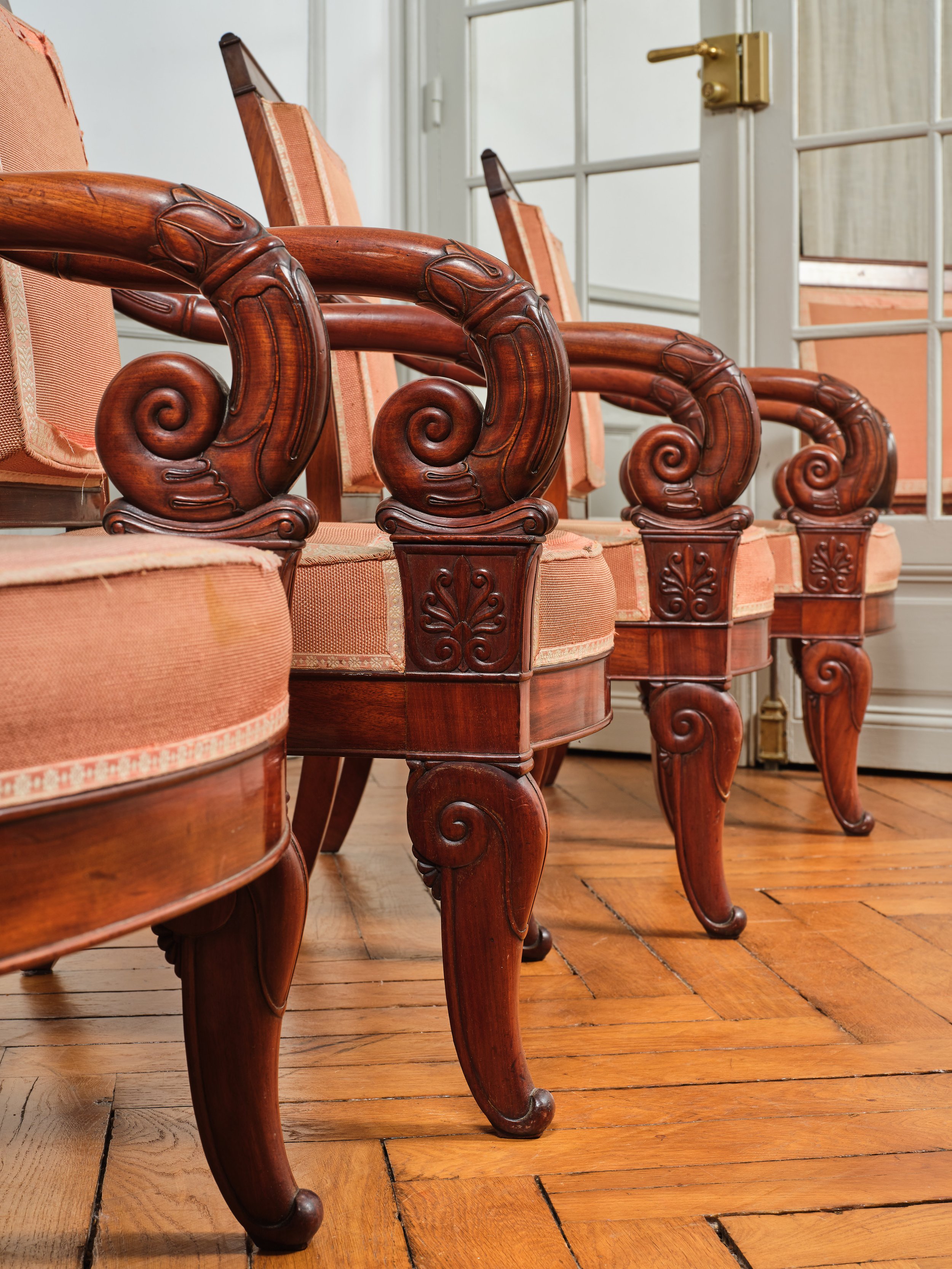
French Mahogany Jeanselme .jpeg
Jeanselme Myers and Monroe.jpeg
Jeanselme Armchairs.jpeg
Summary Block
This block is invalid. Please check the block settings and try again.
Featured
Aenean eu leo Quam

Myers & Monroe, LLC